


Here are a list of some of the common questions many Catholics and non-Catholics have about the teachings of the Catholic Church.
With the help of many good apologetic books and websites, we have given a short answer to each question.
For more comprehensive answers, please refer to the list of links at the end of this page.
Why do Catholics pray to Mary and the saints? Isn't that a form of idolatry?
When Catholics pray to Mary and the other saints in heaven it is not in worship but in fervent request for their prayers on our behalf. The American Heritage Dictionary provides two definitions for the verb ‘pray.’
- To utter or address a prayer or prayers to God, a god, or another object of worship.
- To make a fervent request or entreaty.
You may have heard the second definition used, for example, when a person says “I pray your permission to speak.” This is the definition Catholics mean when they speak about praying to the saints in heaven.
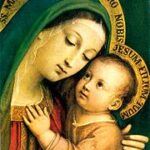 As Scripture indicates, those in heaven are aware of the prayers of those on earth. This can be seen, for example, in Revelation 5:8, where John depicts the saints in heaven offering our prayers to God under the form of “golden bowls full of incense, which are the prayers of the saints.”
Those angels and saints in heaven are aware of our petitions and present them to God by interceding for us. It should be noted that asking one person to pray for you in no way violates Christ’s mediatorship between God and man. St. Paul tells us, “First of all, then, I urge that supplications, prayers, intercessions, and thanksgivings be made for all men, for kings and all who are in high positions, that we may lead a quiet and peaceable life, godly and respectful in every way. This is good, and pleasing to God our Savior, who desires all men to be saved and to come to the knowledge of the truth” (1 Tim. 2:1-4). Intercessory prayers offered by Christians – which is what the saints in heaven are – on behalf of others is something “good and pleasing to God,” not something infringing on Christ’s role as mediator.
Catholics plead the intercession of the saints because we are informed in the Bible that the prayers of certain people are more effective than those of others. “The prayer of a righteous man has great power in its effects” (James 5:16). Since those who are in heaven have been made perfectly righteous and are without sin, their prayers are all the more effective before the throne of God.
For more on this topic: Catholic Answers, Dave Armstrong, Scripture Catholic
Why do Catholics have statues? Doesn't the 1st Commandment forbid the use of "graven images"?
Exodus 20:4 does forbid the making of a “graven image” of God. But what is a graven image? The American Heritage Dictionary defines it as “an idol carved in wood or stone.” In context, then, the Bible clearly forbids idolatry of material things. Worshiping carved wooden blocks or stone is a grave sin, but using them as a visual aid in a religious context is not. We know this because God commanded the construction and use of religious statues in the Bible.
For example:
“And you shall make two cherubim of gold [i.e., two gold statues of angels]; of hammered work shall you make them, on the two ends of the mercy seat. Make one cherub on the one end, and one cherub on the other end; of one piece of the mercy seat shall you make the cherubim on its two ends. The cherubim shall spread out their wings above, overshadowing the mercy seat with their wings, their faces one to another; toward the mercy seat shall the faces of the cherubim be” (Ex. 25:18–20).
During a plague of serpents sent to punish the Israelites during the exodus, God told Moses to “make [a statue of] a fiery serpent, and set it on a pole; and every one who is bitten, when he sees it shall live. So Moses made a bronze serpent, and set it on a pole; and if a serpent bit any man, he would look at the bronze serpent and live” (Num. 21:8–9).
One had to look at the bronze statue of the serpent to be healed, which shows that statues could be used ritually, not merely as religious decorations.
Catholics use statues, paintings, and other artistic devices to recall the person or thing depicted. Just as it helps to remember one’s mother by looking at her photograph, so it helps to recall the example of the saints by looking at pictures of them.
——
For more on this topic: Catholic Answers
Mary wasn't really a virgin her whole life, was she? Doesn't the Bible say that Jesus had brothers? (Matthew 13:55)
While most English translations of the Bible speak of the “brothers” of the Lord in several places in the New Testament, we need to remember that neither Aramaic, the language Jesus probably spoke, nor Hebrew has a separate word for cousin. Instead, the word “brother” is used throughout the Bible to describe persons of close relation (cousins, nephew, etc.). For example, in Genesis we read, “And when Abram heard that his brother [Lot] was taken captive…” (Gen 14:14, King James Version). Yet we know from Genesis 11:27 that Lot is actually the son of Abram’s brother Haran, making Lot Abram’s nephew, not his brother. In Matthew 29:15 Jacob is called the brother of his uncle Laban. Similar uses can be found in 1 Chron 23:21-22, 2 Kings 10:13-14, Dt 23:7 and Jer 34:9. The term “brother” is used even to describe a friend in 2 Sam 1:26 and an ally in Amos 1:9.
Plainly then, the use of the word “brothers” in Scripture is not a convincing argument that Mary had other children besides Jesus.
Another common objection to the Catholic teaching that Mary was an ever-virgin stems from Matthew 1:25: “[Joseph] had no relations with her until she bore a son, and he named him Jesus.”
Some Christians wrongly believe that this passage implies Mary and Joseph had relations after the birth of Jesus. But such an understanding of “until” forces a modern use of the word onto Scripture. In the Bible, the word “until” only means something did not happen to a certain point. It says nothing of what happens after, and should not be read as an implication that events reversed themselves at some later point in time. For instance, in 2 Sam 6:23 we read, “And so Saul’s daughter Michal was childless until the day of her death.” But no one would interpret Scripture to mean that after her death Michal bore children. Similar verses can be found in Ps 110:1 and Gen 8:7.
The Bible makes several strong cases for the Catholic Church’s position that Mary had no children besides Jesus, as outlined by Saint Charles Borromeo Catholic Church (Picayune, MS):
- At the Annunciation Mary asks the angel Gabriel, “How can this be” (Luke 1:34) – a question which makes no sense except in the context of a vow of lifelong virginity.
- The Bible recounts Jesus at the age of 12 being lost for three days and found by his parents in the temple. There is no mention or hint of other children.
- In all of the passages referring to Jesus’ brothers, the authors are careful to only call Jesus the son of Mary, no one else. And in referring to Jesus as “the son of Mary” (Mark 6:3) the force of the Greek implies Jesus was Mary’s only son, not a son.
- In the Jewish society of Our Lord’s time, a younger son would never publicly give an older son advice, much less reproach. Yet we find Jesus’ brethren advising him to leave Galilee and go to Judea to make a name for himself (John 7:3-4). In Mark 3:21 his brethren try to restrain him, saying, “He is out of his mind.” Such passages are understandable if they were in fact Jesus’ uncles or elders.
- Hanging from the Cross, Jesus entrusts his mother’s care to St. John (John 19:26-27). Such an action would be unthinkable if he had other brothers.
That Mary bore one son, Christ Jesus, has been the consistent teaching and belief of Christians down through the centuries. Among other early Church Fathers, Augustine (391-430) described her thus: “a virgin conceiving, a virgin bearing, a virgin pregnant, a virgin bringing forth, a virgin perpetual.”
Protestant Reformers Luther, Calvin and Zwingli likewise believed in Mary’s perpetual virginity. On February 2, 1546 Martin Luther wrote that Mary was “a virgin before the conception and birth, she remained a virgin also at the birth and after it.”
In conclusion then, there is no Biblical evidence that Mary had children besides Jesus. There are, on the other hand, both a strong Biblical case, and the mountain of Christian Tradition, which support the Catholic belief that Mary was indeed an ever-virgin.
—–
For more on this topic: SCBorromeo, Catholic Answers, Scripture Catholic
Why does the Church have a ban on contraception & artificial birth control?
Few realize that before 1930, all Protestant Christian churches agreed with the Catholic Church in condemning the use of artificial contraception as sinful. In 1930 at their decennial Lambeth Conference of bishops, the Church of England was the first to break with Christian tradition and approve the use of artificial birth control in limited circumstances among married couples only. Since then, virtually all Christian churches (including Latter-Day Saints) have followed suit.
Immediately following the 1930 decision of the Anglican Church, Pope Pius XI issued his encyclical on Christian Marriage, Casti Connubii, which included this proclamation:
“Since, therefore, openly departing from the uninterrupted Christian tradition some recently have judged it possible solemnly to declare another doctrine regarding this question [of artificial birth control], the Catholic Church, to whom God has entrusted the defense of the integrity and purity of morals, standing erect in the midst of the moral ruin which surrounds her, in order that she may preserve the chastity of the nuptial union from being defiled by this foul stain, raises her voice in token of her divine ambassadorship and through Our mouth proclaims anew: any use whatsoever of matrimony exercised in such a way that the act is deliberately frustrated in its natural power to generate life is an offense against the law of God and of nature, and those who indulge in such are branded with the guilt of a grave sin.” -Pope Pius XI, Casti Connubii 56, Dec. 31, 1930.
Pius XI’s encyclical concurs with and upholds the Biblical teaching that contraception is wrong. As Catholic Answers rightly notes, the Bible mentions at least one form of contraception specifically and condemns it. Coitus interruptus, was used by Onan to avoid fulfilling his duty according to the ancient Jewish law of fathering children for one’s dead brother. “Judah said to Onan, ‘Go in to your brother’s wife, and perform the duty of a brother-in-law to her, and raise up offspring for your brother.’ But Onan knew that the offspring would not be his; so when he went in to his brother’s wife he spilled the semen on the ground, lest he should give offspring to his brother. And what he did was displeasing in the sight of the Lord, and he slew him also” (Gen. 38:8–10).
The biblical penalty for not giving your brother’s widow children was public humiliation, not death (Deut. 25:7–10). But Onan received death as punishment for his crime. This means his crime was more than simply not fulfilling the duty of a brother-in-law. He lost his life because he violated natural law, as Jewish and Christian commentators have always understood. For this reason, certain forms of contraception have historically been known as “Onanism,” after the man who practiced it, just as homosexuality has historically been known as “Sodomy,” after the men of Sodom, who practiced that vice (cf. Gen. 19).
The Church Fathers likewise agree with Catholic teaching:
“Because of its divine institution for the propagation of man, the seed is not to be vainly ejaculated, nor is it to be damaged, nor is it to be wasted” -Clement of Alexandria, (The Instructor of Children 2:10:91:2 [A.D. 191]).
“This proves that you [Manicheans] approve of having a wife, not for the procreation of children, but for the gratification of passion. In marriage, as the marriage law declares, the man and woman come together for the procreation of children. Therefore, whoever makes the procreation of children a greater sin than copulation, forbids marriage and makes the woman not a wife but a mistress, who for some gifts presented to her is joined to the man to gratify his passion” (The Morals of the Manichees 18:65 [A.D. 388]).
The Catholic Church holds the sexual union of husband and wife to be a sacred gift from God containing in the one act two distinct purposes. The two aspects, or purposes of the marital embrace are the unitive bond between the spouses (i.e., intimacy, pleasure) and the procreative nature of the act (i.e, children). To frustrate the act in order to avoid children in the pursuit of pleasure only is to frustrate the will of God who gave us the gift of human sexuality.
By way of analogy, consider the act of eating. Like sex, eating has two purposes: nutrition and pleasure. When a person decides they want only the pleasure of eating, but not the nutrition — and induces vomiting after meals — society rightly recognizes the disorder and seeks to help the individual restore their diet and eating habits to normalcy, even so far as to offer medical and psychiatric treatment. Contemporary society has no difficulty seeing disorder on the one hand, but paradoxically finds in contraceptives a sort of miracle cure to many of life’s problems: poverty, abortion, sexually transmitted disease, and so on.
Yet rather than serve to eliminate, or even reduce these problems, after decades of social experimentation a strong case can be made that the widespread use of contraceptives in the West has lead to a dramatic increase in promiscuity, marital infidelity, the divorce rate, STDs, and abortion.
For the legitimate intentions on the part of spouses to space, or even avoid the conception of children, the Church teaches that, “Periodic continence, that is, the methods of birth regulation based on self-observation and the use of infertile periods, is in conformity with the objective criteria of morality. These methods respect the bodies of the spouses, encourage tenderness between them, and favor the education of an authentic freedom” (CCC 2370).
——-
For more on this topic: Catholic Answers, Contraception: Why Not?
Why does the Church oppose abortion and euthanasia?
The Church has always taught that from the moment of conception all human life has an intrinsic dignity which must be respected and not violated (CCC 2270). Furthermore, innocent human life may under no circumstances be deliberately destroyed (CCC 2258). Both procured abortion and euthanasia involve the direct, intentional taking of innocent human life, and are therefore a grave offense to God, the Author of life.
————
For more on these questions, please visit the Life Teachings page.
Why do Catholics have a Pope?
Catholics have a Pope (from Latin: “Papa” or “Father”) because the Catholic Church has a visible head in addition to her invisible head, Christ Jesus. The Pope is the Vicar of Christ. A vicar is one who serves as a substitute or agent of another.
Before his death, Christ chose Peter from the twelve to shepherd his flock in his absence. Our Lord charges Peter: “feed my lambs…feed my sheep” (John 21:16-17), constituting Peter guardian of his entire flock in his own place, thus making him his Vicar and fulfilling the promise made in Matthew 16:18-19:
“And so I say to you, you are Peter, and upon this rock I will build my church, and the gates of the netherworld shall not prevail against it. I will give you the keys to the kingdom of heaven. Whatever you bind on earth shall be bound in heaven; and whatever you loose on earth shall be loosed in heaven” (Matt. 16:18-19).

We see Peter’s role as head of the Church played out in the pages of the New Testament. In Acts 1:15, Peter initiates the selection of a successor to Judas soon after Jesus ascended into heaven, and no one questions him. In Acts 5:3, Peter exercises his binding authority, by declaring the first anathema of Ananias and Sapphira which is ratified by God, and brings about their death. In Acts 15:7-12, Peter resolves the first doctrinal issue on circumcision at the Church’s first council at Jerusalem, and no one questions him. After Peter spoke, all were kept silent.
Just as when Judas died, a successor was elected (Acts 1:15), so when Peter died, Linus was elected as Peter’s successor. And after Linus, Cletus. And after Cletus, Clement…and after Paul VI, John Paul. And after John Paul, John Paul II. And after John Paul II, Benedict XVI.
The Catholic Church is the only church which has an unbroken line of succession down through the centuries to Peter, and therefore to Christ himself. You can see the entire list of popes here.
“The Lord says to Peter: ‘I say to you,’ he says, ‘that you are Peter, and upon this rock I will build my Church, and the gates of hell will not overcome it. … ‘ [Matt. 16:18]. On him [Peter] he builds the Church, and to him he gives the command to feed the sheep [John 21:17], and although he assigns a like power to all the apostles, yet he founded a single chair [cathedra], and he established by his own authority a source and an intrinsic reason for that unity. . . . If someone [today] does not hold fast to this unity of Peter, can he imagine that he still holds the faith? If he [should] desert the chair of Peter upon whom the Church was built, can he still be confident that he is in the Church?” -Cyprian of Carthage (The Unity of the Catholic Church 4; first edition [A.D. 251]).
For more on this topic: Catholic Answers, Scripture Catholic, Bible Christian Society
How can the Pope, a mere man, be infallible?
We should probably clarify what we mean and what we don’t mean by papal infallibility. It is a common misapprehension among non-Catholics to think that infallibility means the pope cannot sin. This is not true. The pope is indeed a man guilty of sin like the rest of us. But as the Bible and Christian Tradition demonstrate, he is also a man protected by the Holy Spirit from teaching error with regard to faith or morals. This protection, or charism, also extends to the body of bishops as a whole, when, in doctrinal unity with the pope, they solemnly teach a doctrine as true.
As Catholic Answers explains, we have this from Jesus himself, who promised the apostles and their successors the bishops: “He who hears you hears me” (Luke 10:16), and “Whatever you bind on earth shall be bound in heaven” (Matt. 18:18).
The infallibility of the pope is not a doctrine that suddenly appeared in Church teaching; rather, it is a doctrine which was implicit in the early Church. It is only our understanding of infallibility which has developed and been more clearly understood over time. In fact, the doctrine of infallibility is implicit in these Petrine texts:
When they had finished breakfast, Jesus said to Simon Peter, “Simon, son of John, do you love me more than these?” He said to him, “Yes, Lord, you know that I love you.” He said to him, “Feed my lambs.” He then said to him a second time, “Simon, son of John, do you love me?” He said to him, “Yes, Lord, you know that I love you.” He said to him, “Tend my sheep.” He said to him the third time, “Simon, son of John, do you love me?” Peter was distressed that he had said to him a third time, “Do you love me?” and he said to him, “Lord, you know everything; you know that I love you.” [Jesus] said to him, “Feed my sheep” (John 21:15-17).
“Simon, Simon, behold Satan has demanded to sift all of you like wheat, but I have prayed that your own faith may not fail; and once you have turned back, you must strengthen your brothers” (Luke 22:31-32).
“And so I say to you, you are Peter, and upon this rock I will build my church, and the gates of the netherworld shall not prevail against it. I will give you the keys to the kingdom of heaven. Whatever you bind on earth shall be bound in heaven; and whatever you loose on earth shall be loosed in heaven” (Matt. 16:18-19).
Christ instructed the Church to preach everything he taught (Matt. 28:19-20) and promised the protection of the Holy Spirit to “guide you into all the truth” (John 16:13). That mandate and that promise guarantee the Church will never fall away from his teachings (Matt. 16:18, 1 Tim. 3:15), even if individual Catholics might.
As Christians began to more clearly understand the teaching authority of the Church and of the primacy of the pope, they developed a clearer understanding of the pope’s infallibility. This development of the faithful’s understanding has its clear beginnings in the early Church. For example, Cyprian of Carthage, writing around the year 256, put the question this way, “Would the heretics dare to come to the very seat of Peter whence apostolic faith is derived and whither no errors can come?” (Letters 59 [55], 14). In the fifth century, Augustine succinctly captured the ancient attitude when he remarked, “Rome has spoken; the case is concluded” (Sermons 131, 10).
Some wrongly think infallibility means that popes are given some special grace that allows them to teach positively—prophetically—whatever truths need to be known, but that is not quite correct, either. Infallibility is not a substitute for theological study on the part of the pope.
What infallibility does do is prevent a pope from solemnly and formally teaching as “truth” something that is, in fact, error. It does not help him know what is true, nor does it “inspire” him to teach what is true. He has to learn the truth the way we all do—through study—though, to be sure, he has certain advantages because of his position.
A Common Objection
As a biblical example of papal fallibility, Fundamentalist Christians like to point to Peter’s conduct at Antioch, where he refused to eat with Gentile Christians in order not to offend certain Jews from Palestine (Gal. 2:11-16). For this Paul rebuked him. Did this demonstrate papal infallibility was non-existent? Not at all. Peter’s actions had to do with matters of discipline, not with issues of faith or morals.
Furthermore, the problem was Peter’s actions, not his teaching. Paul acknowledged that Peter very well knew the correct teaching (Gal. 2:12-13). The problem was that he wasn’t living up to his own teaching. Thus, in this instance, Peter was not doing any teaching; much less was he solemnly defining a matter of faith or morals.
Fundamentalists must also acknowledge that Peter did have some kind of infallibility—they cannot deny that he wrote two infallible epistles of the New Testament while under protection against writing error. So, if his behavior at Antioch was not incompatible with this kind of infallibility, neither is bad behavior contrary to papal infallibility in general.
Since Christ said the gates of hell would not prevail against his Church (Matt. 16:18), this means that his Church can never pass out of existence. But if the Church ever apostasized by teaching heresy, then it would cease to exist; because it would cease to be Jesus’ Church. Thus the Church cannot teach heresy, meaning that anything it solemnly defines for the faithful to believe is true. This same reality is reflected in the Apostle Paul’s statement that the Church is “the pillar and foundation of the truth” (1 Tim. 3:15). If the Church is the foundation of religious truth in this world, then it is God’s own spokesman. As Christ told his disciples: “He who hears you hears me, and he who rejects you rejects me, and he who rejects me rejects him who sent me” (Luke 10:16).
——-
For more on this topic: Catholic Answers, EWTN
Why can't priests marry?
Like many questions asked of the Catholic Church, this is another about which there is a great deal of confusion. The most basic confusion is thinking of priestly celibacy as a dogma or doctrine—a central and irreformable part of the faith, believed by Catholics to come from Jesus and the apostles—though it is not. Many non-Catholics would be surprised to learn that even today celibacy is not the rule for all Catholic priests. In fact, for Eastern Rite Catholics, married priests are the norm, just as they are for Orthodox and Oriental Christians.
Even in the Eastern churches, though, there have always been some restrictions on marriage and ordination. Although married men may become priests, unmarried priests may not marry, and married priests, if widowed, may not remarry. Moreover, there is an ancient Eastern discipline of choosing bishops from the ranks of the celibate monks, so their bishops are all unmarried.
The tradition in the Western or Latin Rite Church has been for priests as well as bishops to take vows of celibacy, a rule that has been firmly in place since the early Middle Ages. Even today, though, exceptions are made. For example, there are married Latin Rite priests who are converts from Lutheranism and Episcopalianism.
As these variations and exceptions indicate, priestly celibacy is not an unchangeable dogma but a disciplinary rule. The fact that Peter was married (Mark 1:30) is no more contrary to the Catholic faith than the fact that the pastor of the nearest Maronite Catholic church is married.
Although most people are at some point in their lives called to the married state, the vocation of celibacy is explicitly advocated—as well as practiced—by both Jesus and Paul. In 1 Corinthians 7 Paul teaches, “To the unmarried and the widows I say that it is well for them to remain single as I am. But if they cannot exercise self-control, they should marry. For it is better to marry than to be aflame with passion” (7:8-9).
He goes on, “Are you free from a wife? Do not seek marriage. . . those who marry will have worldly troubles, and I would spare you that. . . . The unmarried man is anxious about the affairs of the Lord, how to please the Lord; but the married man is anxious about worldly affairs, how to please his wife, and his interests are divided. And the unmarried woman or girl is anxious about the affairs of the Lord, how to be holy in body and spirit; but the married woman is anxious about worldly affairs, how to please her husband” (7:27-34).
Paul’s conclusion: He who marries “does well; and he who refrains from marriage will do better” (7:38). Paul merely echoes Christ’s teaching:
“Not all can accept this word, but only those to whom it is granted. Some are incapable of marriage because they were born so; some, because they were made so by others; some, because they have renounced marriage for the sake of the kingdom of God. Whoever can accept this ought to accept it” (Matt. 19:11-12).
Notice that this sort of celibacy “for the sake of the kingdom” is a gift, a call that is not granted to all, or even most people, but is granted to some.
Celibacy is neither unnatural nor unbiblical. “Be fruitful and multiply” is not binding upon every individual; rather, it is a general precept for the human race. Otherwise, every unmarried man and woman of marrying age would be in a state of sin by remaining single, and Jesus and Paul would be guilty of advocating sin as well as committing it.
Most Catholics marry, and all Catholics are taught to venerate marriage as a holy institution—a sacrament, an action of God upon our souls; one of the holiest things we encounter in this life. In fact, it is precisely the holiness of marriage that makes celibacy precious; for only what is good and holy in itself can be given up for God as a sacrifice. Just as fasting presupposes the goodness of food, celibacy presupposes the goodness of marriage. To despise celibacy, therefore, is to undermine marriage itself—as the early Fathers pointed out.
Celibacy is also a life-affirming institution. In the Old Testament, where celibacy was almost unknown, the childless were often despised by others and themselves; only through children, it was felt, did one acquire value. By renouncing marriage, the celibate affirms the intrinsic value of each human life in itself, regardless of offspring.
Finally, celibacy is an eschatological sign to the Church, a living-out in the present of the universal celibacy of heaven: “For in the resurrection they neither marry nor are given in marriage, but are like angels in heaven” (Matt. 22:30).
——-
For more on this topic: Catholic Answers, Fr. Groeschel
What's the difference between mortal and venial sin?
Mortal sin is a grave sin whereby we knowingly and willfully violate God’s law in a serious matter, for example, idolatry, adultery, murder, slander. These are all things gravely contrary to the love we owe God and, because of Him, our neighbor. Mortal sin is called mortal because it is the “spiritual” death of the soul (separation from God). We find a direct reference to it in 1 John 5:16-17:
“If anyone sees his brother sinning, if the sin is not deadly, he should pray to God and he will give him life. This is only for those whose sin is not deadly. There is such a thing as deadly sin, about which I do not say that you should pray. All wrongdoing is sin, but there is sin that is not deadly” (1 John 5:16-17).
If we are in the state of grace, mortal sin loses this supernatural life for us. If we die without repenting we will lose God for eternity. However, by turning our hearts back to Him and receiving the Sacrament of Penance we are restored to His friendship.
Venial sins, on the other hand, are slight sins. They do not break our friendship with God, although they injure it. They involve disobedience of the law of God in slight (venial) matters. If we gossip and destroy a person’s reputation it would be a mortal sin. However, normally gossip is about trivial matters and only venially sinful.
It is always good to remember, especially those who are trying to be faithful but sometimes fall, that for mortal sin it must not only be 1) serious matter, but 2) the person must know it is serious and then 3) freely commit it.
These two categories of sin, mortal and venial, are explicitly to be found in Sacred Scripture. In the Old Covenant there were sins that merited the death penalty and sins that could be expiated by an offering. This Law was a teacher that prepared the way for the faith (Gal. 3:24). In the New Covenant these material categories are replaced by spiritual ones, natural death by eternal death. There are thus daily faults for which we must daily ask forgiveness (Matt. 6:12), for even the “just man falls seven times a day” (Prov. 24:16), and mortal faults that separate the sinner from God (1 Cor. 6:9-10) for all eternity.
The testimony of the early Christian Church confirms the Catholic teaching which acknowledges a distinction between mortal and venial sin:
“There are venial sins and there are mortal sins. It is one thing to owe ten thousand talents, another to owe but a farthing. We shall have to give an accounting for an idle word no less than for adultery. But to be made to blush and to be tortured are not the same thing; not the same thing to grow red in the face and to be in agony for a long time. . . . If we entreat for lesser sins we are granted pardon, but for greater sins, it is difficult to obtain our request. There is a great difference between one sin and another” –Jerome (Against Jovinian 2:30 [A.D. 393]).
For more on this topic: Catholic Answers, EWTN, Fr. Mike Schmitz
Why do Catholics have to confess their sins to a priest? Can't we just be remorseful, and confess our sins directly to God, instead of some intermediary?
Some non-Catholics think that the sacrament of confession (also called penance, or reconciliation) is extra-Biblical in its origin and was merely an invention of the Catholic Church to exercise authority and control. But as we shall see, confession was instituted by Christ, and not some later pope or bishop.
Perhaps it would be worthwhile to consider the history of man for just a moment. After the fall of Adam and Eve in the Garden of Eden from God’s grace into sin, Heaven itself was shut as nothing unclean could enter it (Rev 21:27) and mankind was in a period of waiting for the savior God had promised (Gen 3:15, Jn 3:16). Meanwhile, throughout the Old Testament we find God’s people—the Jews—offering animal sacrifices, inadequate though they were, in atonement for sin (Gen 4:4, Lev 3, Ex 12:3-8). Through his redemptive work on the cross, Christ—the “Lamb of God” (Jn 1:36)—is the perfect sacrifice which satisfies the justice required for sin. It is satisfactory because Jesus, being fully God supplies infinite reparation. And, being fully man, he does so in our name, on our behalf.
He has redeemed all of mankind. We are no longer forbidden entry into Heaven; the gates have been re-opened. However, our attaining eternal life demands a response on our part as well; it is offered to us, but cannot be taken for granted. We must—in brief—believe in Jesus Christ (Jn 6:28, Acts 16:30), be born again and baptized (Jn 3:31, 1 Pet 3:21), confess our sins (1 Jn 1:9), deny ourselves, take up our cross, and follow him (Mk 8:34).
But the point to appreciate here is that confession of one’s sins to another human being is, and always has been, an integral part of Christian life. For example, “Many of those who were now believers came [to St. Paul], confessing and divulging their practices” (Acts 19:18). And again in James 5:16 the Bible says, “[C]onfess your sins to one another…that you may be healed.”
So confessing our sins to one another is a Biblical teaching, but what about the question of a man forgiving sin? Well, this question was actually posed some 1500 years prior any challenge to Catholicism by the Protestant Reformation. It was raised by the Jews who were appalled at Jesus’ words—words they were sure constituted blasphemy. This question, and answer, is relayed in the Gospel of Luke chapter 5, a passage worth re-examining here:
And some men brought on a stretcher a man who was paralyzed; they were trying to bring him in and set (him) in his presence. But not finding a way to bring him in because of the crowd, they went up on the roof and lowered him on the stretcher through the tiles into the middle in front of Jesus. When he saw their faith, he said, “As for you, your sins are forgiven.” Then the scribes and Pharisees began to ask themselves, “Who is this who speaks blasphemies? Who but God alone can forgive sins?” Jesus knew their thoughts and said to them in reply, “What are you thinking in your hearts? Which is easier, to say, ‘Your sins are forgiven,’ or to say, ‘Rise and walk’? But that you may know that the Son of Man has authority on earth to forgive sins”–he said to the man who was paralyzed, “I say to you, rise, pick up your stretcher, and go home.” He stood up immediately before them, picked up what he had been lying on, and went home, glorifying God (Lk 5:18-25).
There are at least two profound realities Our Lord is conveying in this text. The first is the gravity of sin itself (all too often downplayed by the sinner) and the full extent of the miraculous power required to forgive it. This point is illustrated by Christ’s question to the scribes, “Which is easier, to say, ‘Your sins are forgiven,’ or to say, ‘Rise and walk’?” With our human minds, which, same as the scribes, are darkened and clouded by sin, it would seem that the easier statement to make is, “Your sins are forgiven.” Our reasoning is perhaps twofold: (1) there is no burden of proof which must be presented to the skeptic that indeed any sins were forgiven, and (2) if someone had such power, we tend to think of spiritual healing as less miraculous than physical. But Christ asked the question so as to reveal the truth that what seems easier to us (forgiving sin) is actually a much greater task than merely curing physical paralysis.
The second reality revealed here, of course, is that Jesus Christ, the God-man, does have the power to forgive sin.
And this brings us back to our original question. Can a man forgive sin? Yes; Christ exercised the power to forgive sin while he walked the Earth. And after his resurrection from the dead, he appeared to his apostles and handed over that same power to them:
Jesus said to them again, “Peace be with you. As the Father has sent me, so I send you.” And when he had said this, he breathed on them and said to them, “Receive the holy Spirit. Whose sins you forgive are forgiven them, and whose sins you retain are retained” (Jn 20:21-23).
There is only one other place in Scripture where God breathes on man. In the story of creation, God breathes life into the soul of the first man, Adam. After conquering death, the Bible tells us God breathes on his apostles which emphasizes the importance of this moment.
This is where the Catholic practice of confessing sins to a priest and receiving absolution originates. Its basis is scriptural and its practice has been in existence from the very beginning of Christianity. St. Paul wrote, “God has reconciled us to Himself through Christ and has given us the ministry of reconciliation” (2 Cor 5:18). And the Didache (or Teachings of the Twelve Apostles), written about 80 AD, states, “In the congregation you shall confess your transgressions,” and, “On the Lord’s Day, come together and break bread…having confessed your transgressions that your sacrifice may be pure.”
St. Cyprian writing in the year 251 said, “Let each confess his sin while he is still in this world, while his confession can be received, while satisfaction and the forgiveness granted by the priests are still pleasing before the Lord.”
And St. John Chrysostom wrote:
Priests have received a power which God has given neither to angels nor to archangels. It was said to them: “Whatsoever you shall bind on earth shall be bound in heaven; and whatsoever you shall loose, shall be loosed.” Temporal rulers have indeed the power of binding; but they can only bind the body. Priests, in contrast, can bind with a bond which pertains to the soul itself and transcends the very heavens. Did [God] not give them all the powers of heaven? “Whose sins you shall forgive,” he says, “they are forgiven them; whose sins you shall retain, they are retained.” What greater power is there than this? The Father has given all judgment to the Son. And now I see the Son placing all this power in the hands of men [Matt. 10:40; John 20:21–23]. They are raised to this dignity as if they were already gathered up to heaven (The Priesthood 3:5 [A.D. 387]).
On a practical level, it is easy to see the wisdom in this sacrament. God often includes men in his plans (spreading the Gospel, praying and interceding for one another), including his plan of reconciling the sinner. And in light of our human nature, confessing our sins to another human being demands a deeper level of humility, of contrition, of sorrow for our failings. Conversely, it is more psychologically satisfying than confessing to an unseen God.
People today have little trouble spending hundreds of dollars in fees to psychologists and psychiatrists, who listen to the woes and wrongdoing in their patients’ lives. But a psychologist can only offer human consolation, not the Divine consolation and peace that comes by way of a Catholic priest with the power to forgive sin.
The true beauty of this sacrament was perhaps captured best by Blaise Pascal:
The Catholic religion does not compel indiscriminate confession of sins; it allows us to remain hidden from the sight of all other men, save one to whom she bids us reveal the depths of our heart, and show ourselves as we are….Can anything be imagined more charitable, more tender? –Blaise Pascal, d. 1662
Links & References
- Praying to the Saints-Catholic Answers,
- Communion of Saints:Biblical Introduction & Overview
- Saints and Intercessory Prayer
- Do Catholics Worship Statues?
- Mary’s Perpetual Virginity (1994)
- What the Early Church Believed: The Perpetual Virginity of Mary
- The Blessed Virgin Mary
- What the Early Church Believed: Mortal Sin